Case study · product and service design for 2040
Therapod
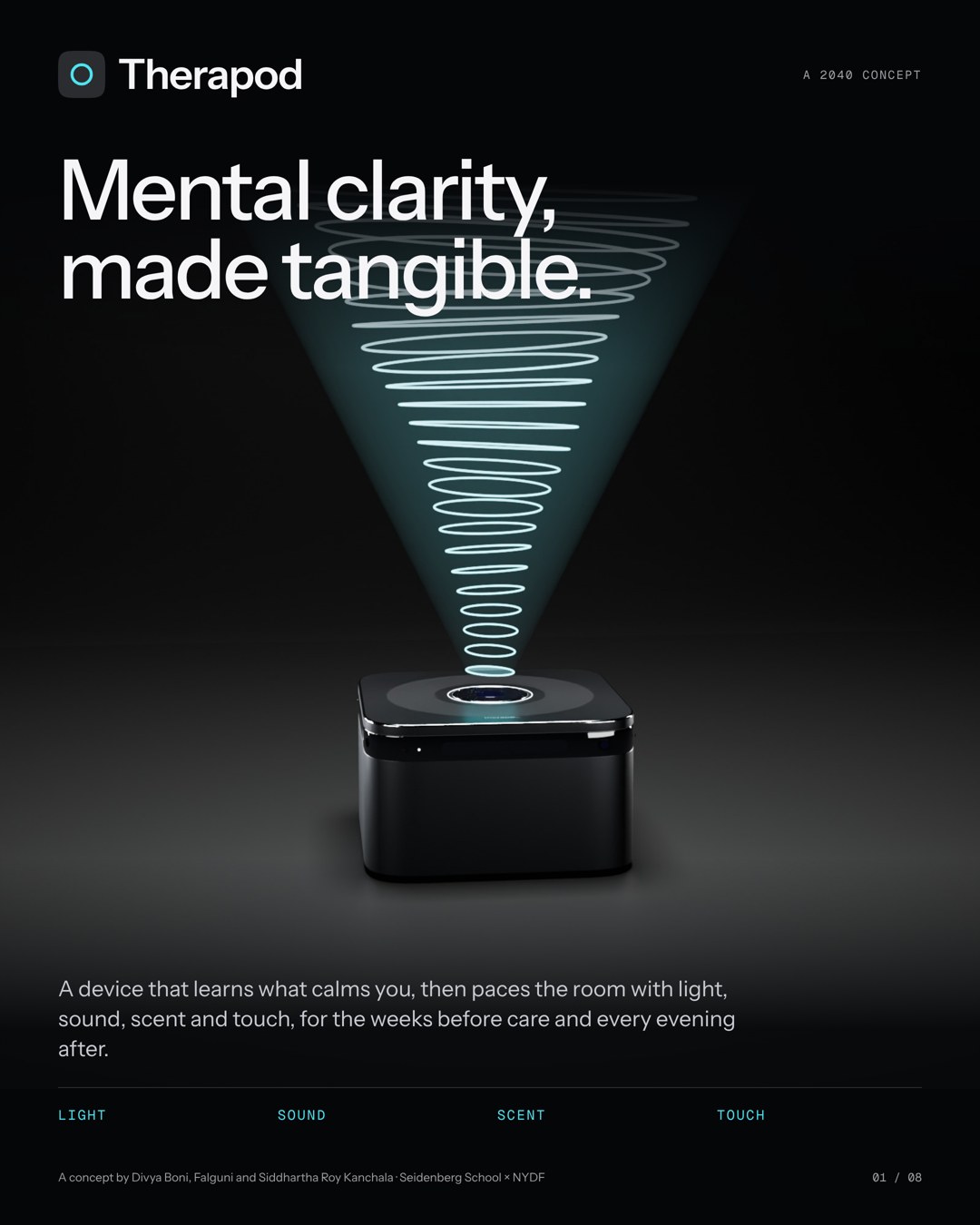
Mental clarity, made tangible.
A room that listens to your body, learns what calms you, and keeps you steady through the weeks before care.
The 60-second version
Help is weeks away. Therapod is there tonight.
Problem
When someone finally asks for help, the first appointment is often weeks away. Those weeks are lived alone, at home, and the apps people try are dropped fast.
Insight
In 12 interviews people asked for quiet, not advice, and for senses, not screens. They wanted to feel understood without feeling watched.
Solution
A device that reads breath, heart and warmth, learns what calms you, and paces light, sound, scent and touch to one rhythm. It bridges the wait for care, then keeps you steady after.
My part
I worked on it end to end: research, discovery, the device, the service blueprint, the brand, the app, the films and a working 3D build.
Problem
Help is weeks away. The stress isn't.
Deciding to get help is hard. Then comes the wait. For weeks, often months, people carry it alone at home, and the tools they try in the meantime don't stick.
US adults aged 18–29 with anxiety symptoms, 2019 to 2022
NCHS, 2024of psychiatrists contacted offered a new patient an appointment; the median wait was 67 days
Sun et al., 2023of fully remote workers felt a lot of stress the day before; 24% felt lonely
Gallupof US adults with a mental illness got any treatment in 2024
SAMHSA NSDUHAmericans live where there aren't enough mental health professionals
HRSA, 2025of users a mental health app still has after 15 days (median of 93 apps)
Baumel et al., 2019Our question
What if the weeks before care felt different? Something in your own room that learns how you calm down, keeps you steady, and hands you over to a person when it's time.
Why 2040
We designed for a plausible future, not for today.
We started from Arup's 2050 Scenarios and chose "Humans Inc.": people live better than ever while the planet gets harsher. Arup calls it the path we are already on. Today's signals point the same way:
- Home is the office. About a quarter of US paid workdays are worked from home. WFH Research
- Rooms are getting smart. 59% of North American homes are forecast to be smart homes by 2029. Berg Insight
- Loneliness is a health issue. About 1 in 6 people worldwide are lonely. WHO, 2025
- The future itself is a worry. 59% of 16–25-year-olds are very or extremely worried about climate change. Hickman et al., 2021
How people may feel in 2040
Tired of being "always on", while technology watches them more than ever.
Connected all day, and still alone at night.
Uneasy about the future, and wanting small moments of control.
Wary of anything that reads their emotions. This last one shaped the whole design.
Our speculative read of these signals. No credible statistical projection to 2040 exists for mental health.
Research
12 interviews, four themes, and one tension that became the brief.
We ran semi-structured interviews with people who manage stress at home. The themes are shown as themes, not percentages, because 12 people can't support percentages.
Inside our research board
Scroll sideways · tap any board to enlarge
Give me space, not advice.
People wanted quiet, not something talking at them.
Senses over screens.
Sound, light and scent felt more comforting than another app or a conversation.
Privacy and control come first.
People wanted to decide when and how they are helped.
Still, be understood.
Some wanted something that "gets" their state without having to explain it.
Themes 3 and 4 pull against each other. The brief: help people feel understood without ever feeling watched.
The tensionSophia Miller, 28. Junior graphic designer, works from home in New York. Generalised anxiety and work-related low mood. She tried Calm and Headspace and couldn't keep it up. She has finally booked a therapist, and the first appointment is six weeks away.
She needs something for the evenings until then: relief that takes no effort, adds no screen time, and gets to know her without making her explain herself.
Principle 1
Ask nothing.
One tap to start. No coaching voice, no goals, no streaks.
Principle 2
Learn her, quietly.
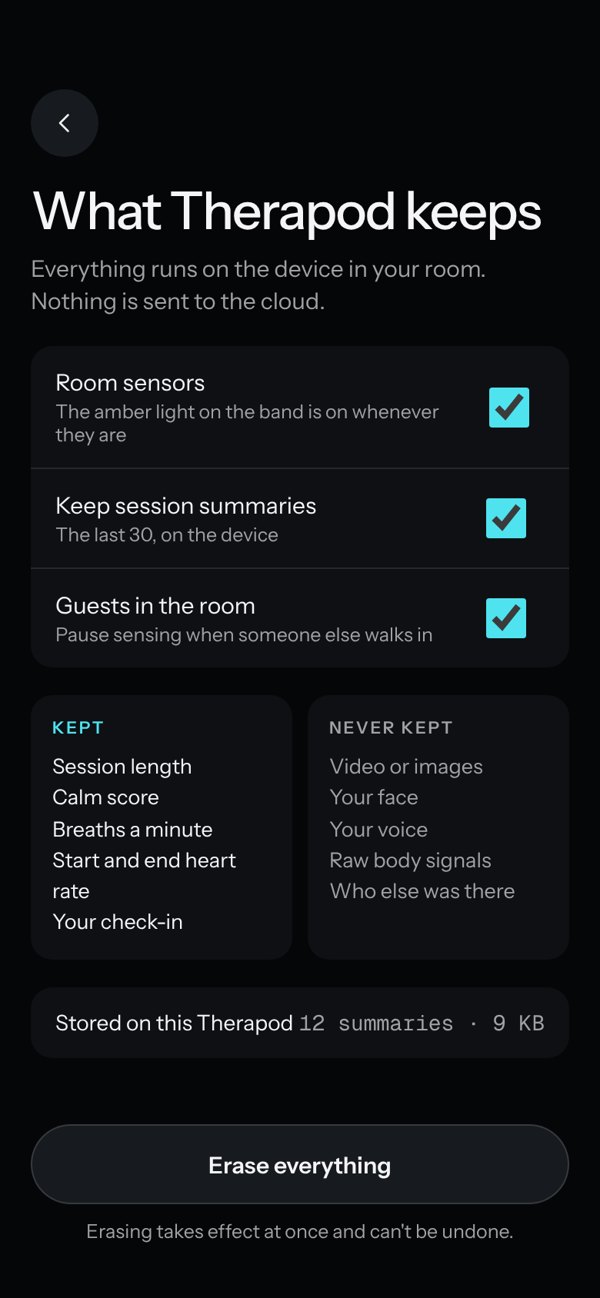
Every session teaches it what calms her. She can see all of it, and change or erase it.
Principle 3
Private by default.
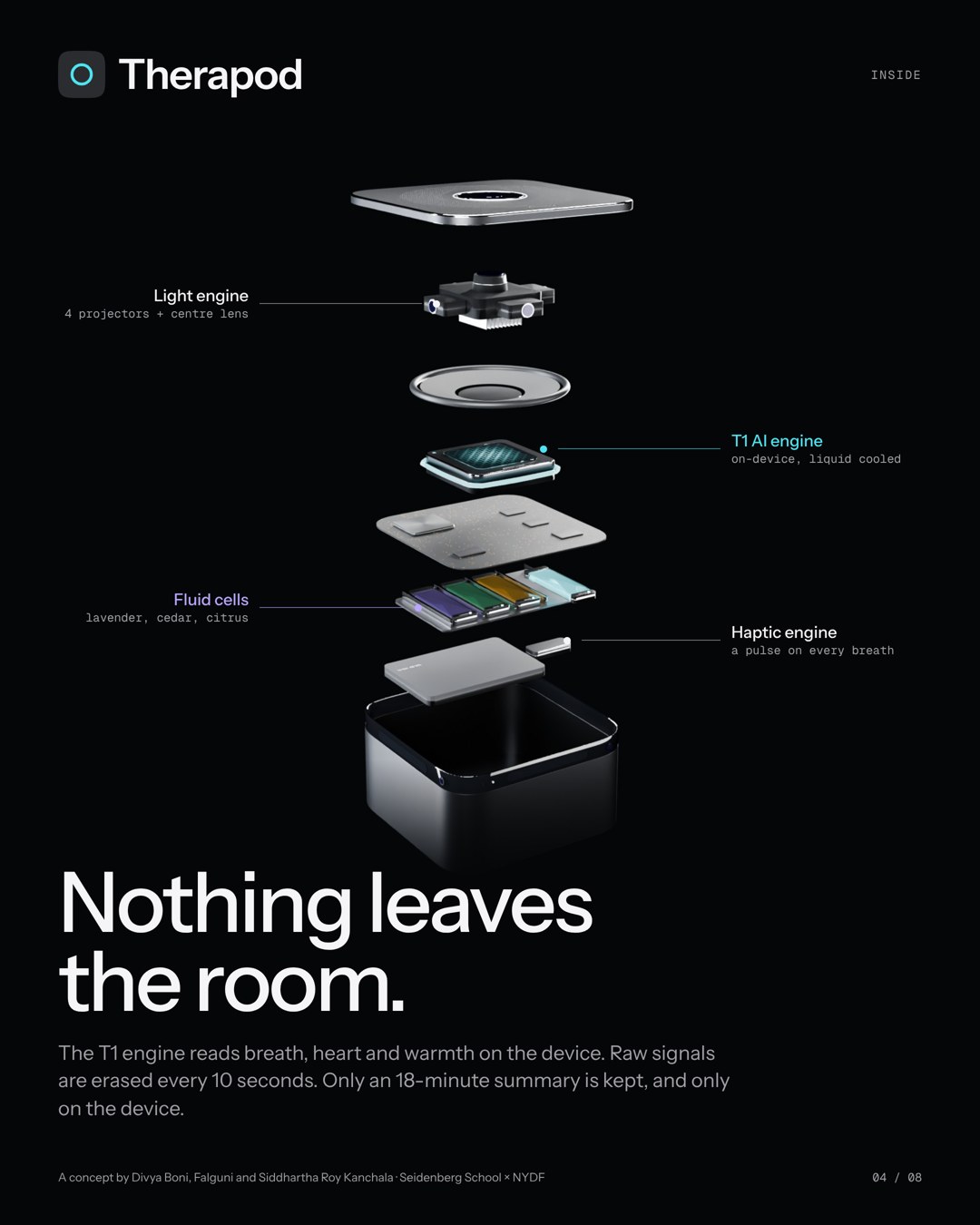
Body signals only, every model on the device, and nothing leaves the room unless she sends it.
Principle 4
A bridge to people.
It never diagnoses. It helps her reach care and arrive steadier, and offers a person when it's more than stress.
Concept
One device. Four senses. One rhythm.
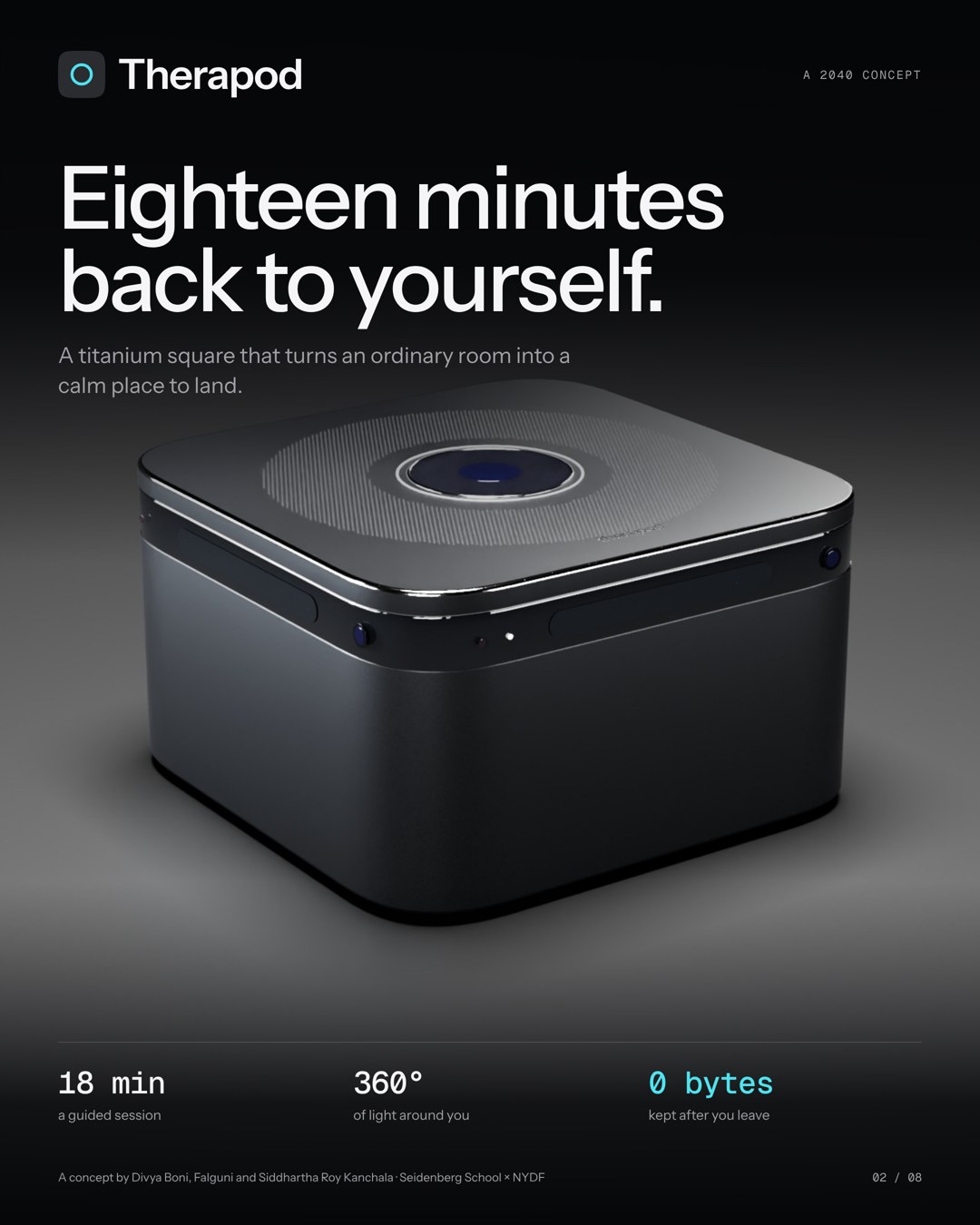
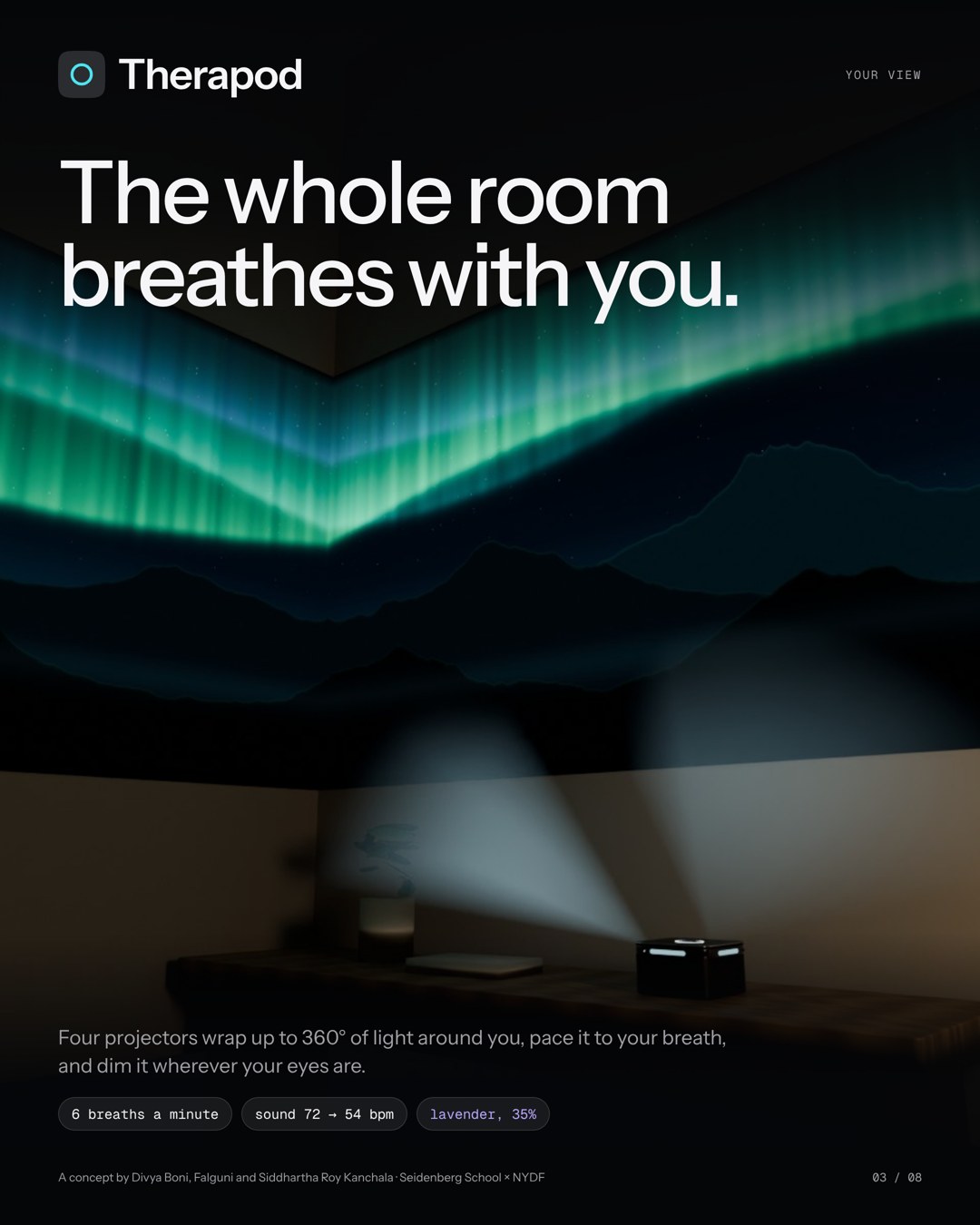
Therapod sits on a console and turns the room into an 18-minute place to settle. Everything it does follows a single breath rhythm, slowing towards six breaths a minute, and every session it learns a little more about what works for the person in front of it.
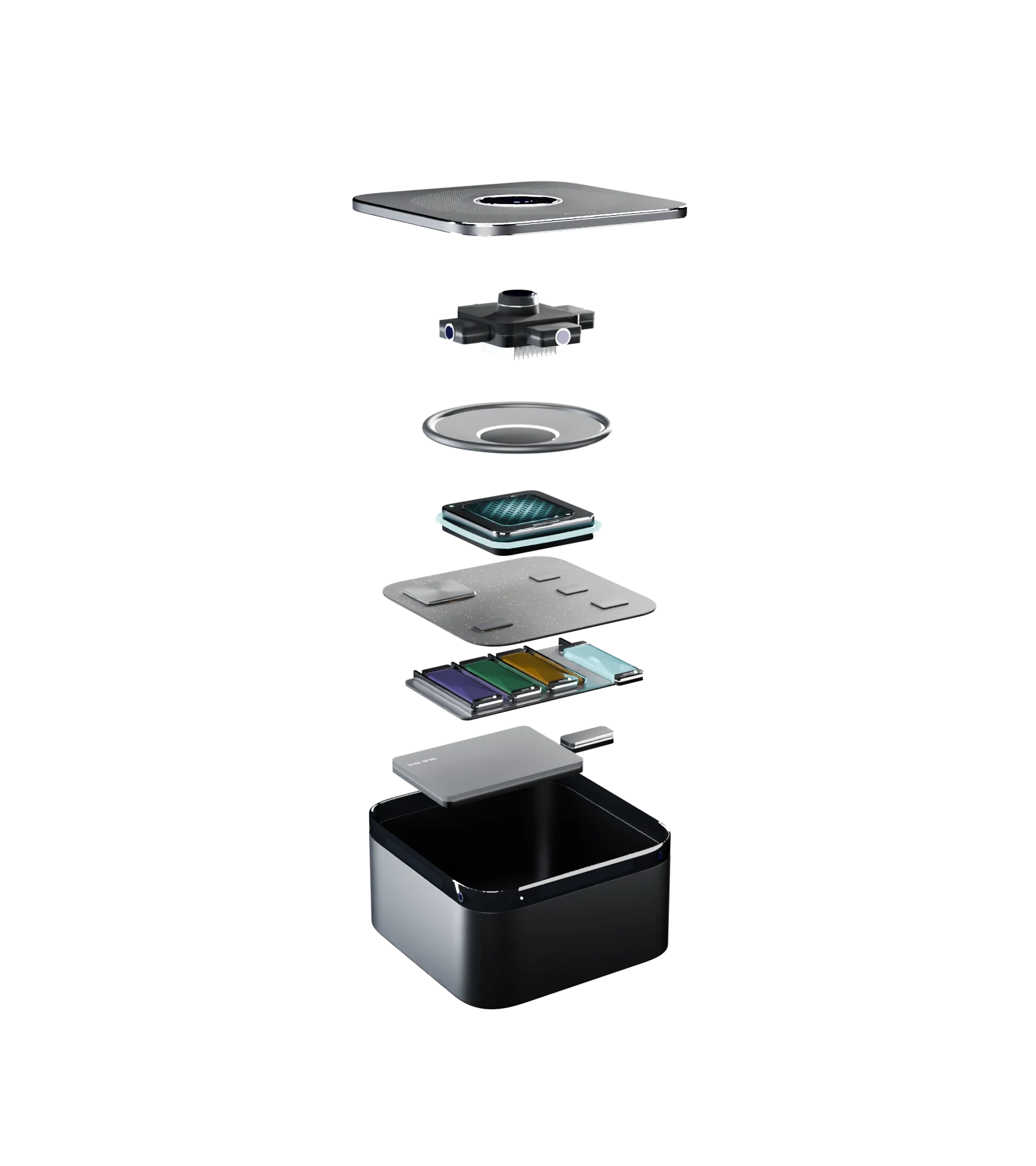
Inside
- Light engineA centre lens for the floating summary, plus four short-throw projectors.
- T1 AI engineRuns every model on the device, kept cool by a liquid loop.
- Fluid cellsLavender, cedar and citrus, each matched to a scene. Slide in like cartridges.
- Glass bandFour sensors, four projector windows and a privacy light software can't switch off.
- Haptic engineA soft pulse on every breath.
Form
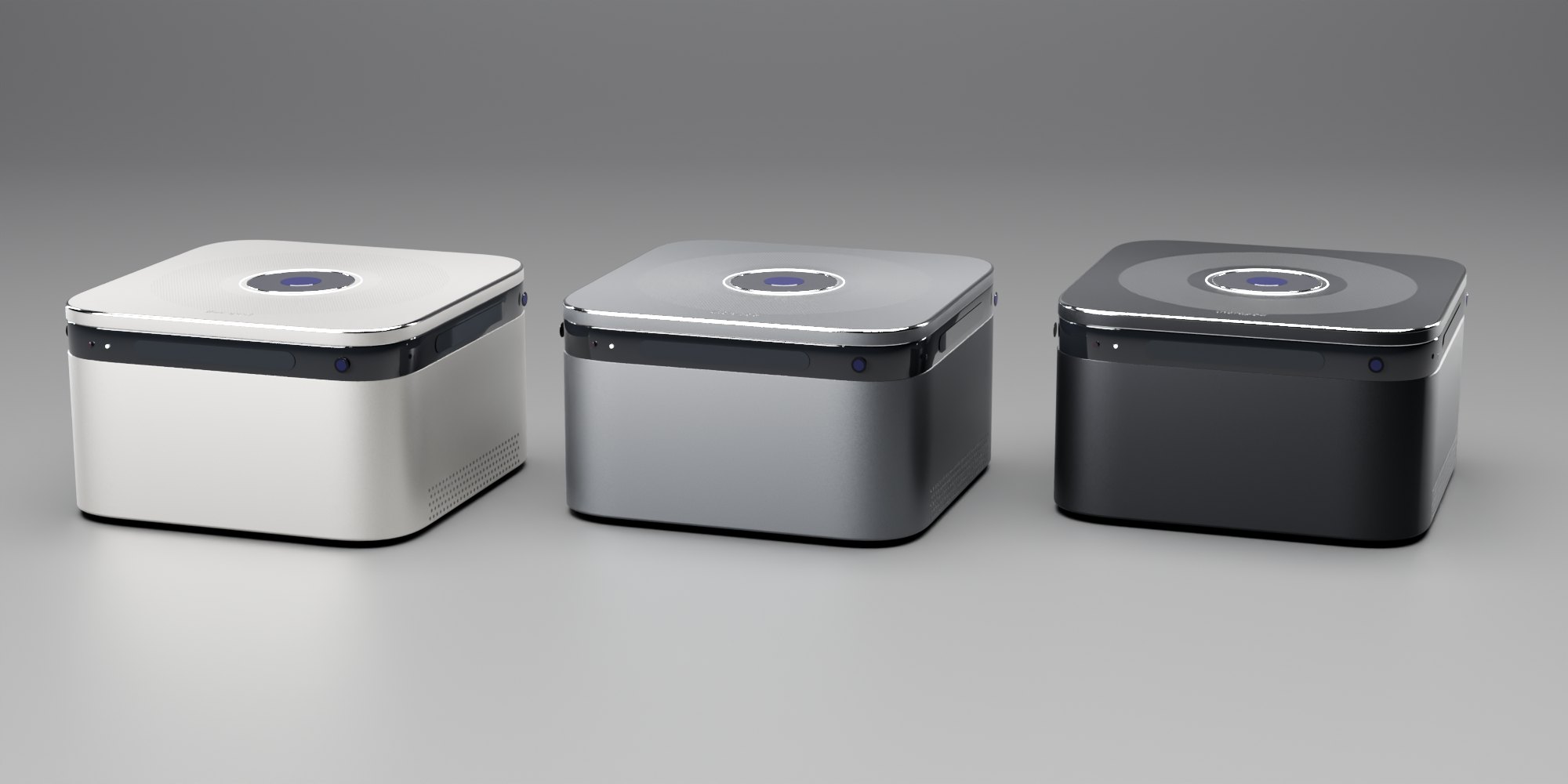
We explored cubes and spheres, then chose the cube.
A cube is stable on a desk, gives a flat top to project from, and puts the controls where hands reach. Spheres felt friendly but roll, and a curved top distorts the light.
Where it sits
At home, nothing combines several senses with adaptive sensing.
Today's calm devices either sense you and use one or two senses, or use several senses and sense nothing. Adaptive multisensory pods exist, but only in hotels, airports and offices.
Evidence
Five design decisions, each backed by research.
The first concept was built on what felt calming. I tested each idea against published studies and what we heard in interviews, kept what holds up and changed what didn't.
Breathing became the core.
FIRST IDEAOne therapy among four.
FINALEvery sense follows one breath rhythm, slowing to about six breaths a minute.
Paced breathing with heart-rate biofeedback cut stress and anxiety by a large margin across 24 studies (g ≈ 0.83). Goessl et al.
Sensing stays minimal.
FIRST IDEATrack as many signals as possible to infer mood.
FINALSensors read breathing, heart rate and warmth only. Her check-in outranks all of them.
Privacy and control came first in our interviews, and 60% of Americans would be uncomfortable with a provider relying on AI for their care. Fewer signals, kept on the device, keep trust. Pew 2023
It learns her, then steps back.
FIRST IDEAThe same session for everyone, chosen from a menu.
FINALPace, scene, scent, length and timing adapt to her over time. She can see, change or erase everything it learns.
The breathing rate that calms the body most varies from person to person, around six a minute, so biofeedback is tuned to each individual. And people told us they wanted to be understood without explaining. Lehrer & Gevirtz 2014
The senses must agree.
FIRST IDEAAny scent with any scene; peppermint as a default.
FINALEvery scene has a matched scent, and each sense switches off on its own.
Video, sound and scent together lifted mood more than any single sense, but a mismatched scent made relaxation worse. Max Planck 2025 Lopes 2024
One score, never a grade.
FIRST IDEANo feedback, so no reason to come back.
FINALOne calm score per session and three readings. No streaks, no comparisons.
The score describes the session, not the person. Mental health apps lose almost everyone within weeks, and guilt-driven streaks make leaving feel like failing.
Experience
One evening, 9:40 pm. Eighteen minutes.
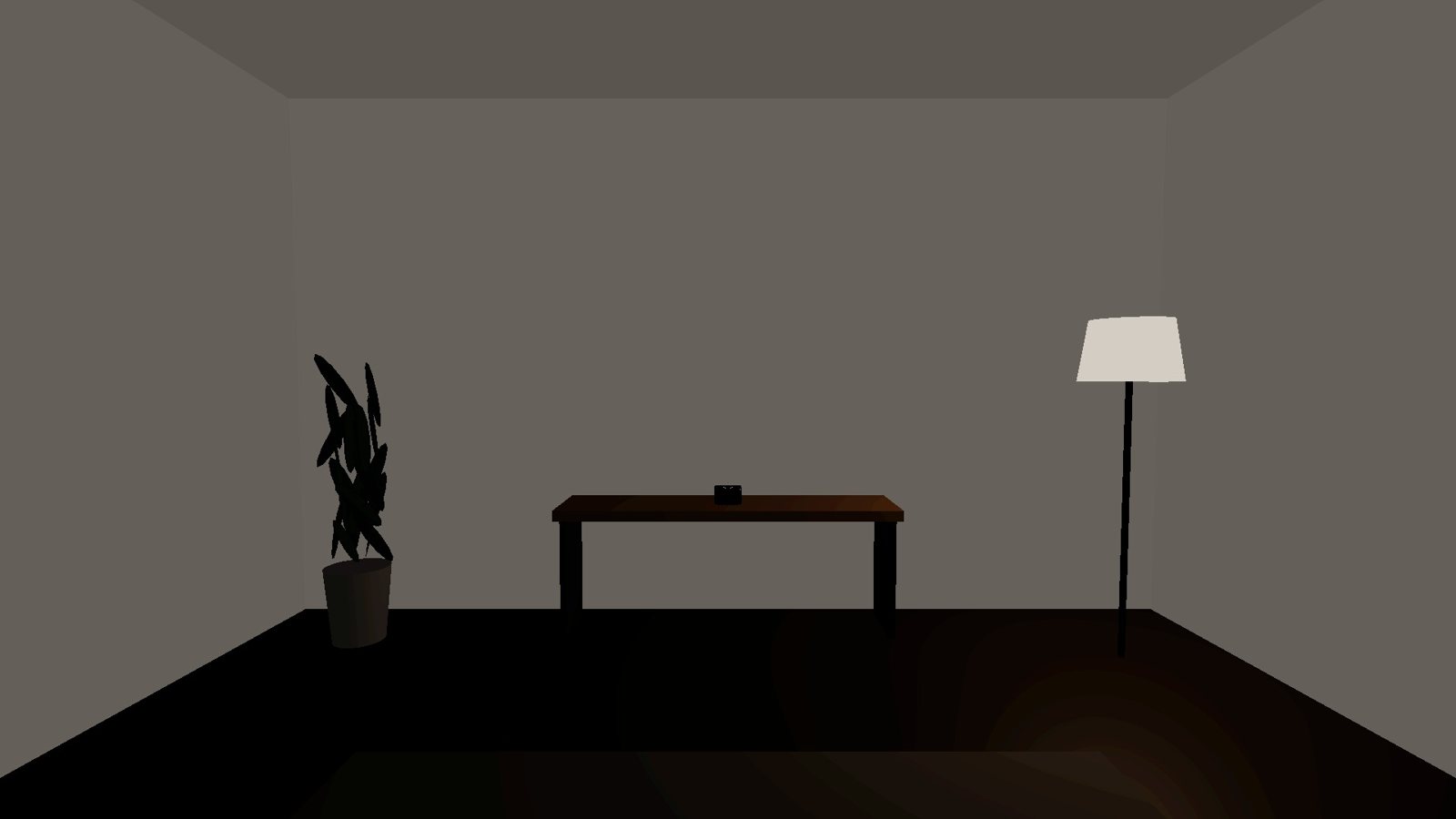
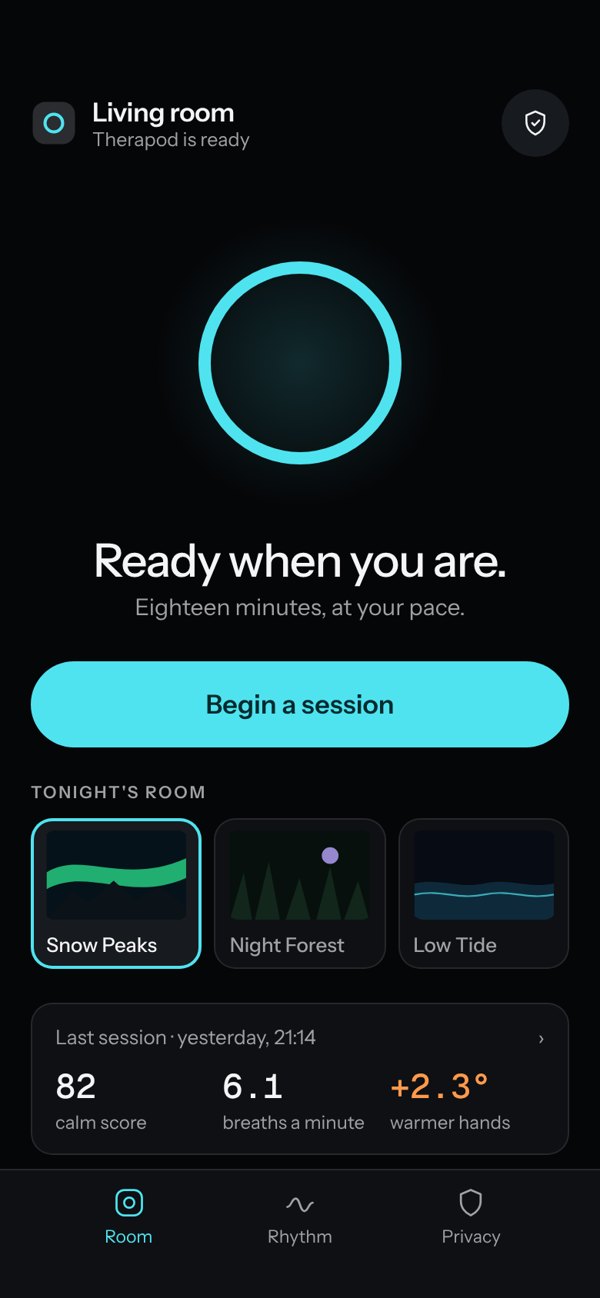
What Sophia sees in the room and on her phone, and what Therapod is doing. The app is the quietest part of the product: used before and after, never during.
"Wired. Shoulders up since noon."
One tap to begin. The amber light on the band shows the sensors are on, and they can be switched off.
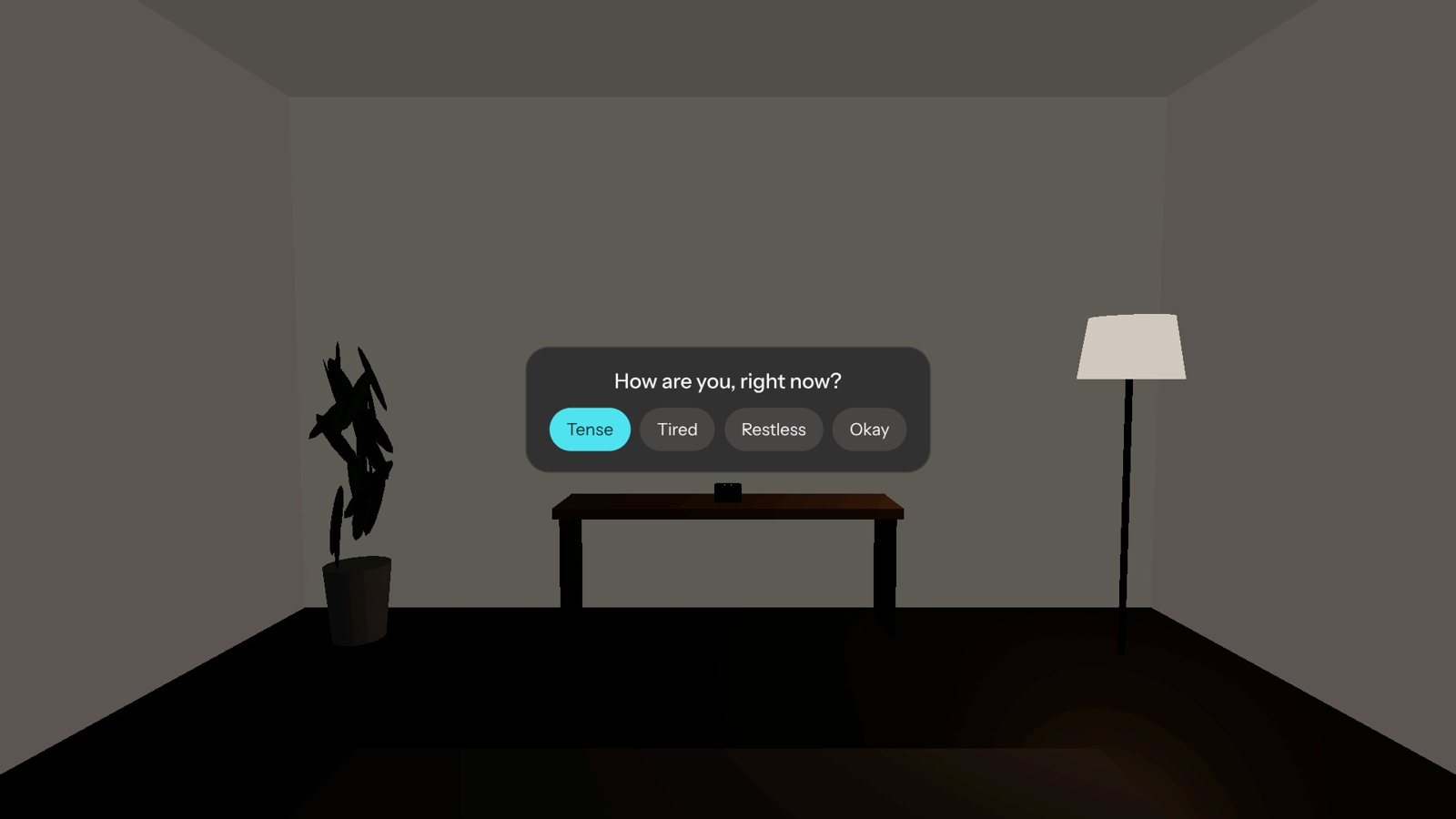
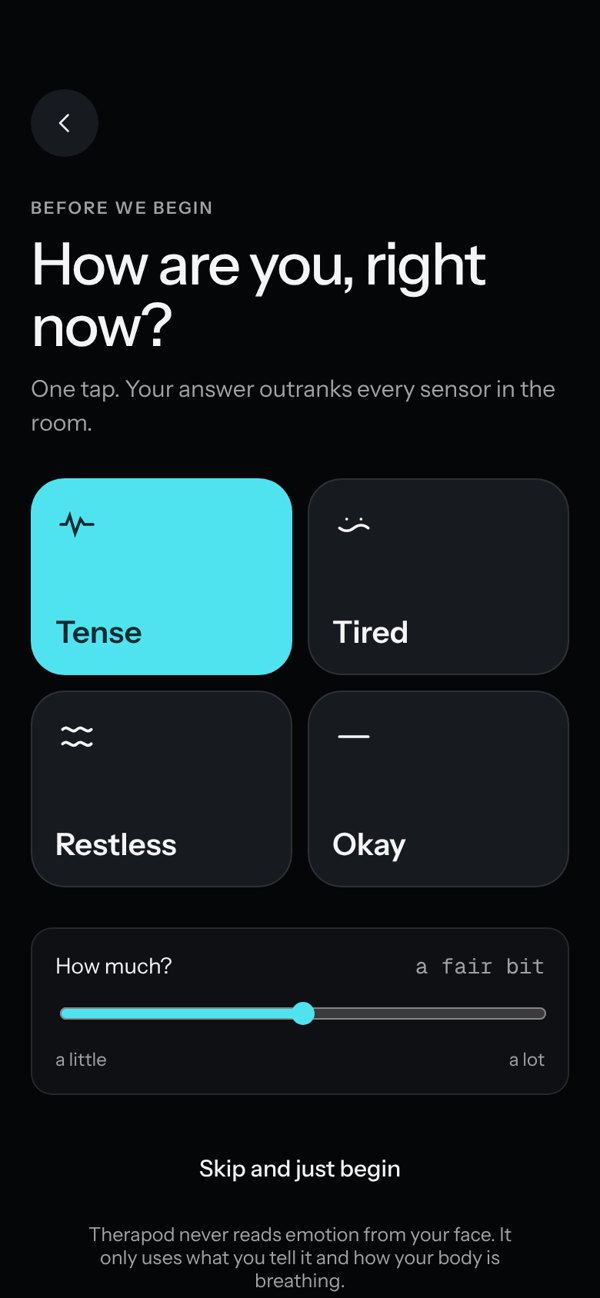
"Heard, without having to explain."
One question, one tap. Her answer outranks every sensor. Therapod sets the starting pace from it.
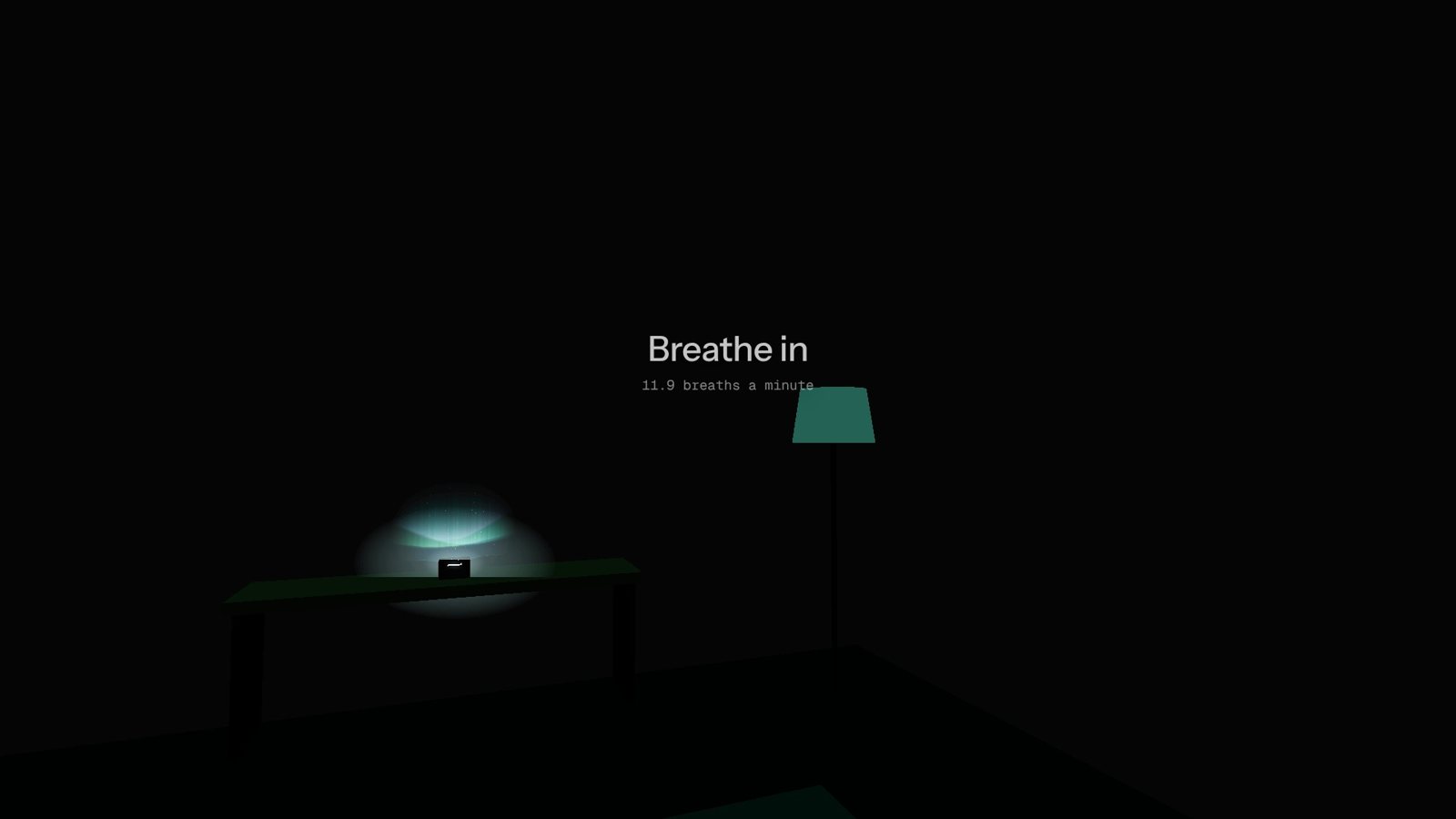
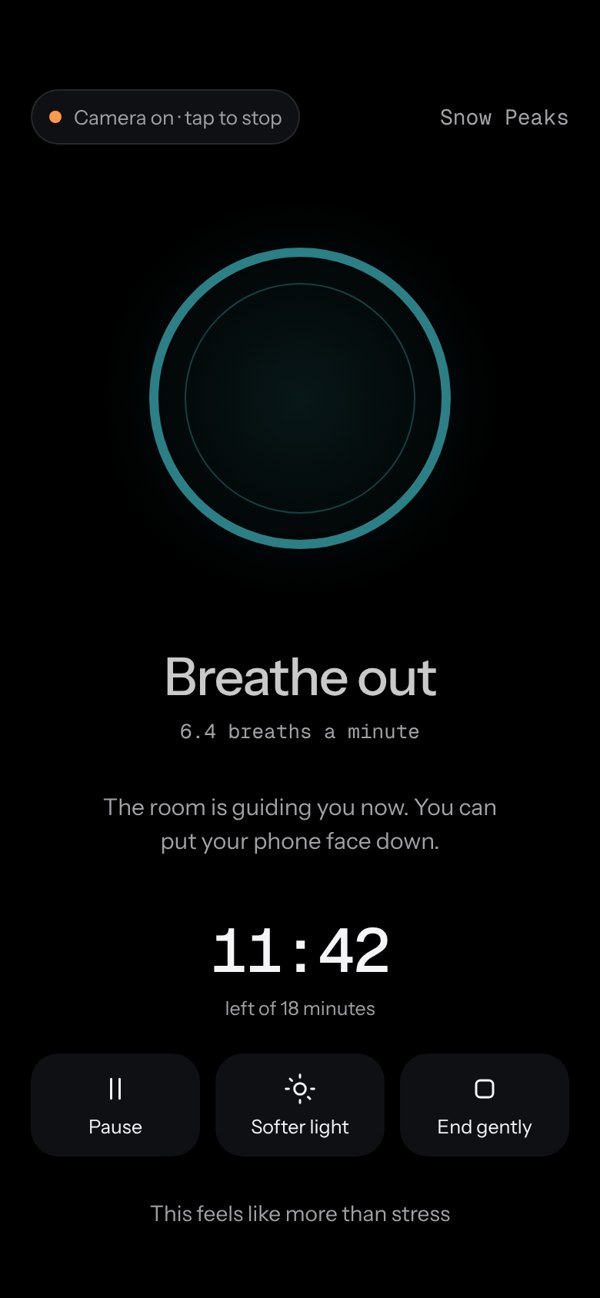
"I can put the phone down."
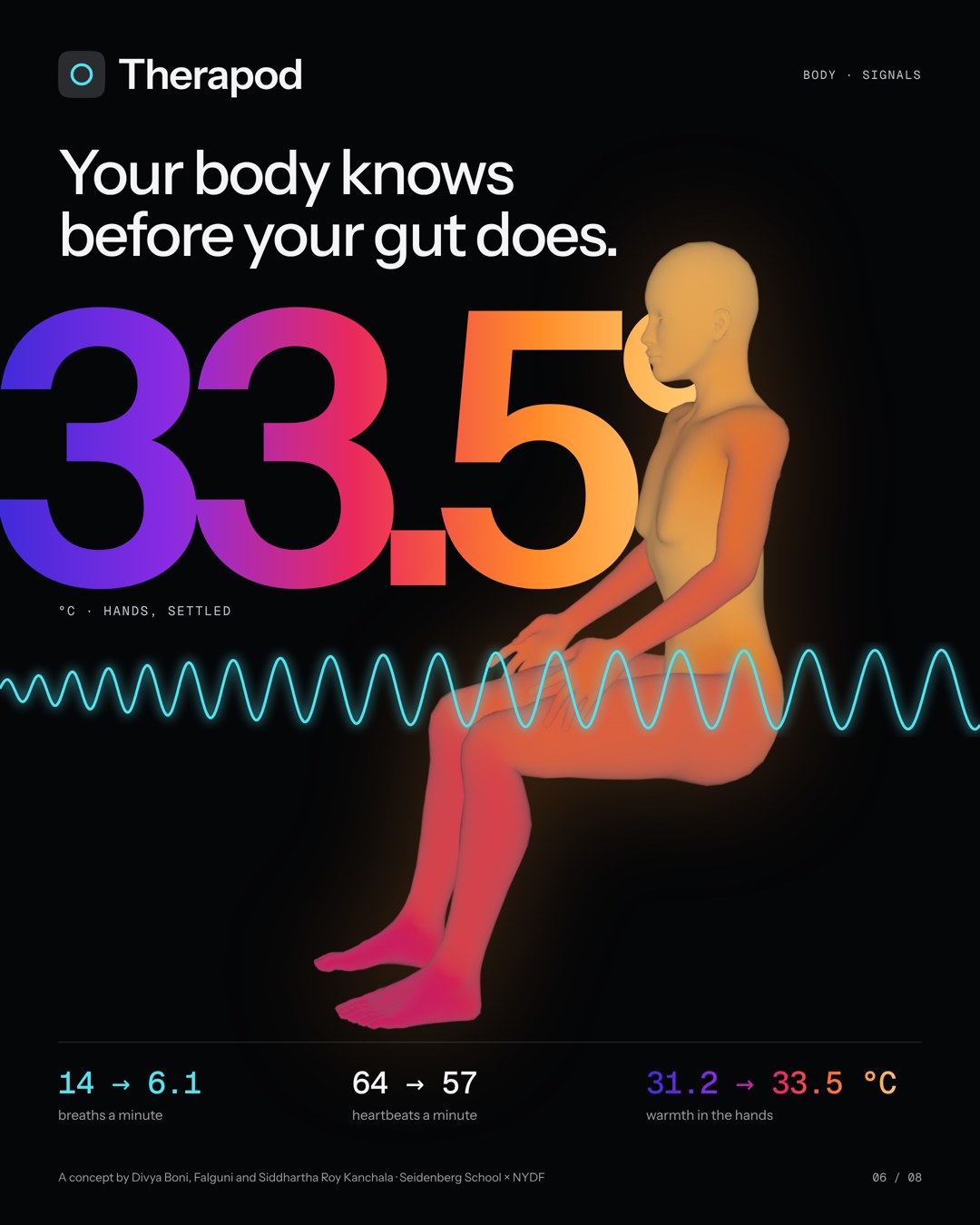
The phone goes dark. The ring paces her breath from 14 a minute down towards 10. Sound enters at 72 bpm.
"Shoulders drop."
The whole room breathes. Light wraps the walls and ceiling and dims around her eyes. Lavender at 35%. Breath settles near six a minute.
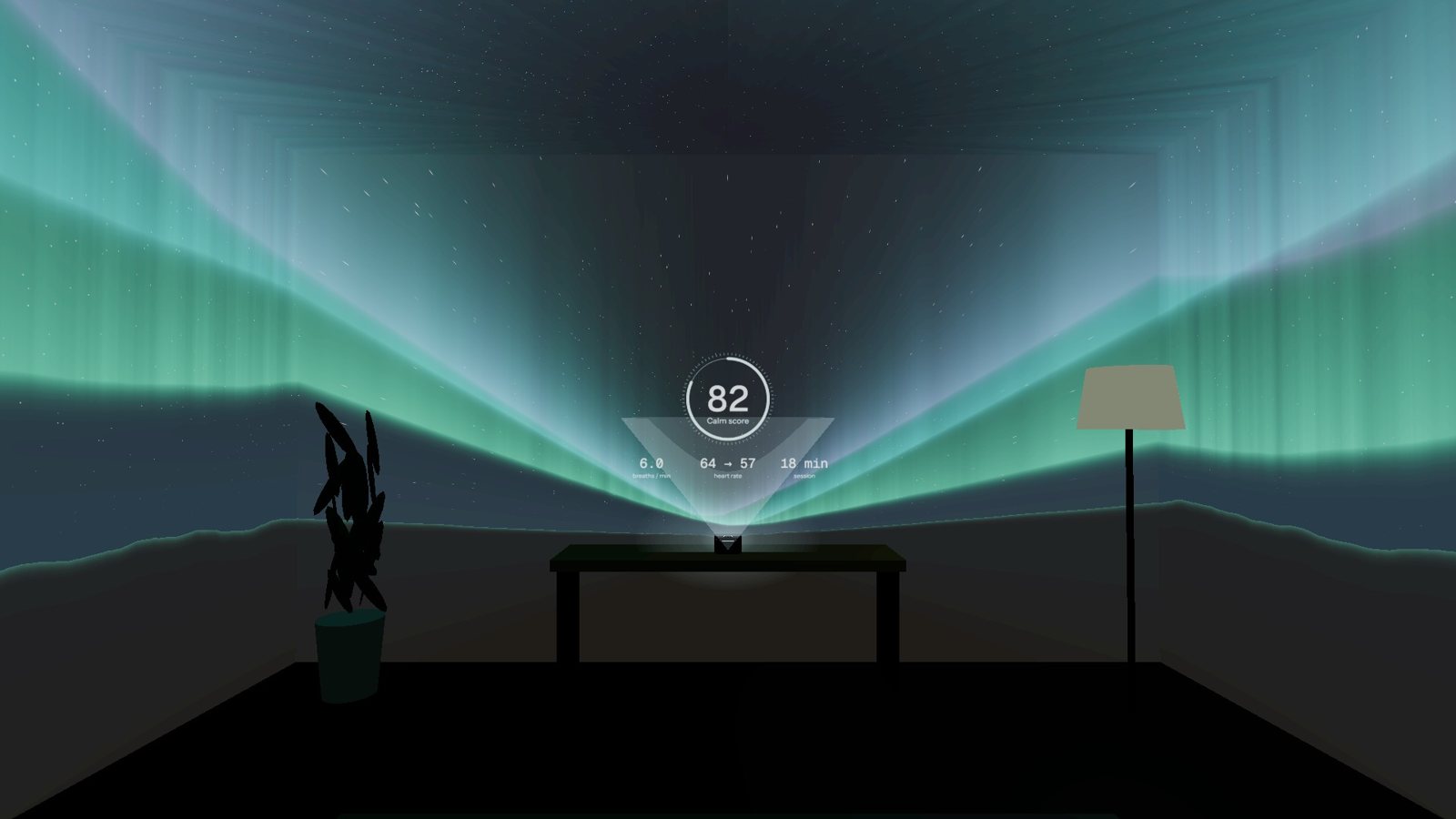
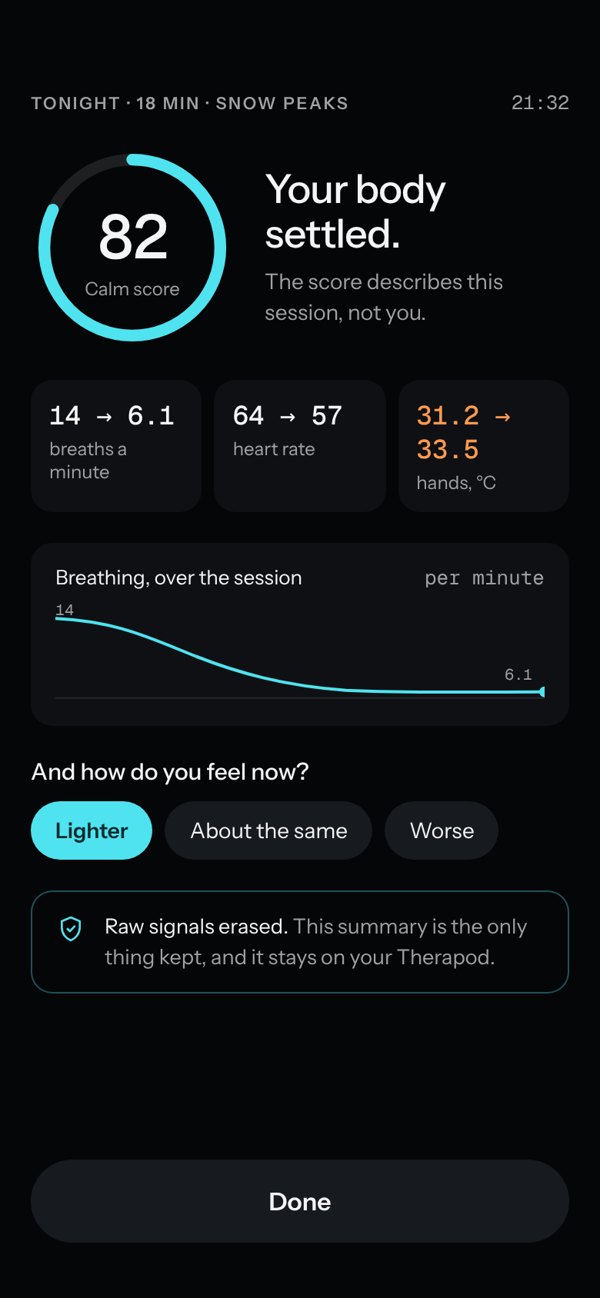
"Lighter."
Light fades over 60 seconds. A floating summary, then her own answer: how does she feel now? Raw signals are erased.
Learns you
It gets better at being hers.
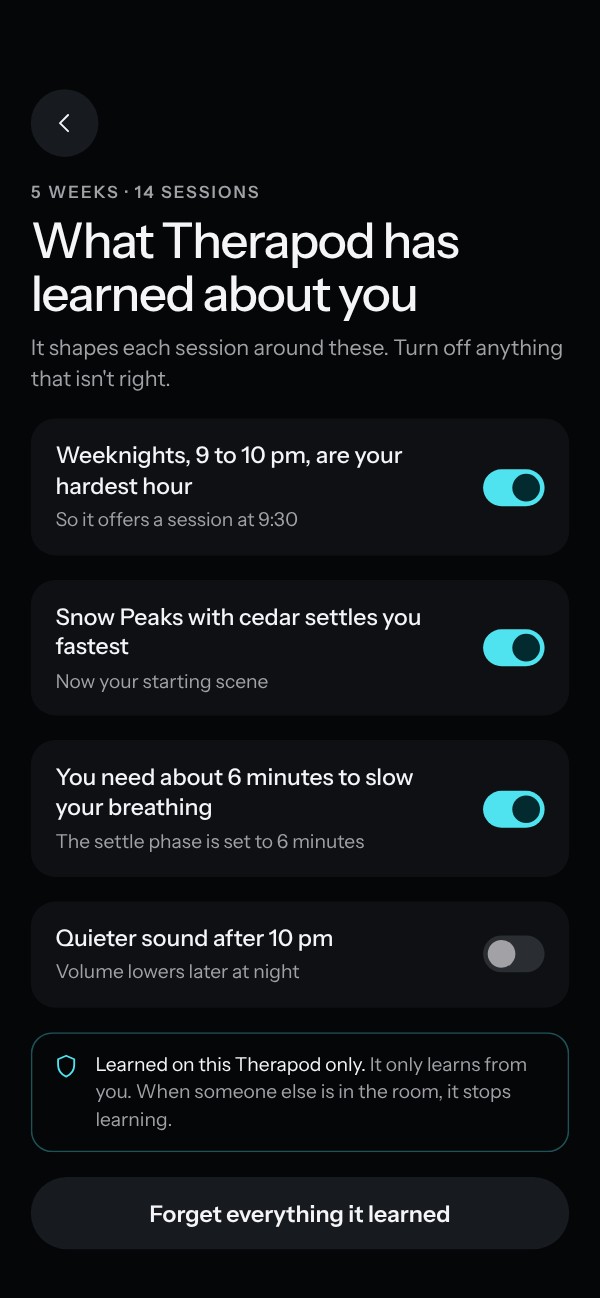
Therapod isn't a library of sessions to pick from. It notices what actually works for her and shapes the next evening around it, on the device, where she can see it.
Starts from her check-in and a gentle default. Notes how fast her breathing slows and which scene she lets run.
Her settle phase grows to six minutes. Lavender didn't help, so it tries cedar with Snow Peaks, and her score climbs.
It knows weeknights from 9 to 10 pm are the hardest and offers a session at 9:30, before she has to ask.
What it learns
- When she tends to be tense
- How long she takes to settle
- The scenes, scents and sound levels that help
- Her own words from each check-in
What it never learns
- Anyone else in the room
- Her voice, her image or her location
- Anything outside a session
- Anything she has switched off or erased
Before the first appointment
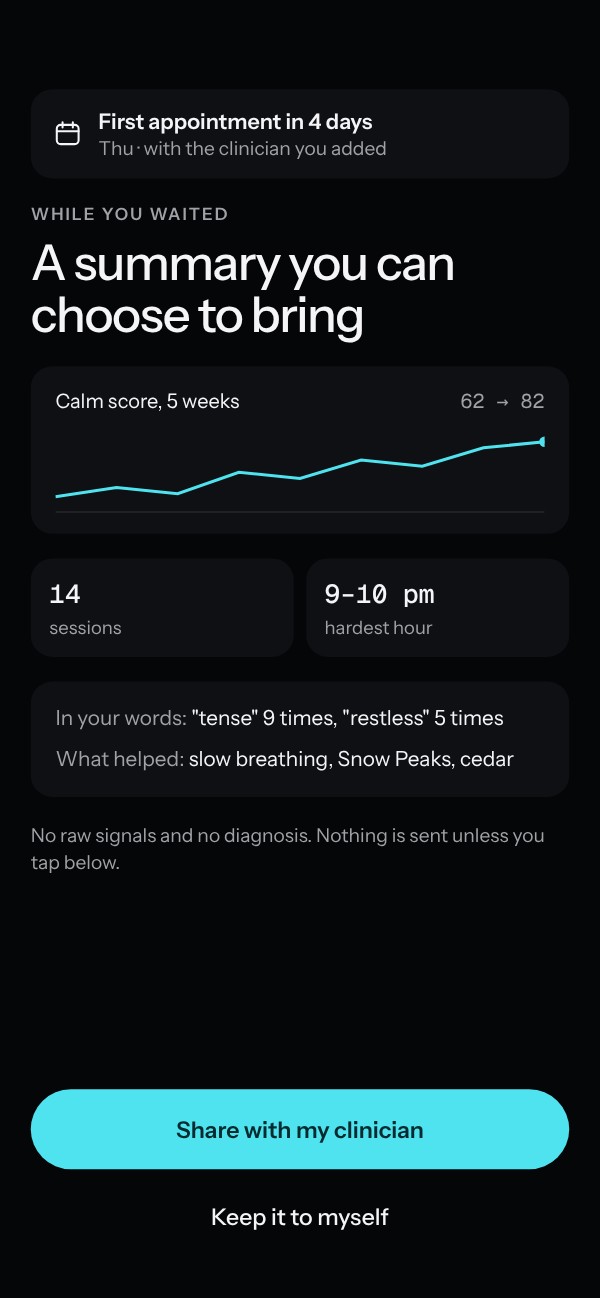
She arrives steadier, and can bring the weeks with her.
Days before the appointment, Therapod offers a one-page summary of the wait: how often she used it, her hardest hours, what helped, and her own words. There are no raw signals and no diagnosis, and it's only shared if she taps "Share with my clinician".
After that first visit, Therapod doesn't hand over and disappear. It keeps her pace between sessions, for as long as she wants it.
Service design
A service, not a gadget.
A device, an app, rules about data, and a hand-off to people when it matters. The blueprint shows where trust has to be made visible on purpose.
| Set uponce | Arrive9:40 | Check-in9:41 | Settle9:44 | Immerse9:50 | Close9:58 | Reflectlater | Appointmentweeks later | Reach outonly when needed | |
|---|---|---|---|---|---|---|---|---|---|
| Sophia does | Pairs the app, chooses which sensors to allow | Sits down, taps once | Answers "How are you, right now?" | Follows the breath ring | Lets the room take over | Lets it fade, or stops anytime | Glances at a summary | Chooses whether to share the summary | Sees "This feels like more than stress" |
| Therapod shows | "What I sense, what I never keep" | Soft light, amber sensor light on | Mirrors her answer | Ring at the starting pace, low sound | Light, sound, scent and pulses layer in one at a time | 60-second fade, floating summary | Patterns, never grades | "A summary you can choose to bring" | A trusted person, a therapist, or 988 |
| On the device | Consent stored locally | Sensors start; nothing leaves | Check-in and heart rhythm combined; check-in wins | Breath read live to set the pace | Engine tunes intensity to her response | Summary kept; raw signals erased | Learns from the session; summary kept on the device | Builds the summary; sends nothing until she taps | Fires only on her words |
| Support | App, firmware | Sensor band, hardware light | Local model | Breath engine, haptics | Projectors, fluid cells, speaker | Local storage | App | App, her clinician | Her contacts, therapist, 988 |
| Proof she sees | Consent card | The amber light | Her own words | The ring | The room itself | "Raw signals erased" | A weekly card | "Share with my clinician" | The prompt, with "not now" |
Line of visibility. Everything below it is invisible to Sophia, which is exactly why three things are shown on purpose: the sensor light, what is sensed, and what is erased.
When things go wrong
Every failure has a designed recovery.
Her check-in wins, and one tap corrects the reading.
A full session runs on the check-in and the breath ring. Nothing is locked.
It switches to a shared session: no personal sensing, no learning, nothing kept.
Stop ends everything within 2 seconds. No "are you sure?"
Scent is opt-in each session, and "no scent" is a full mode.
Breath and sound run locally on battery. Nothing depends on the cloud.
No guilt notifications. One gentle note after 14 days, then quiet.
Therapod stops and offers people. It never diagnoses.
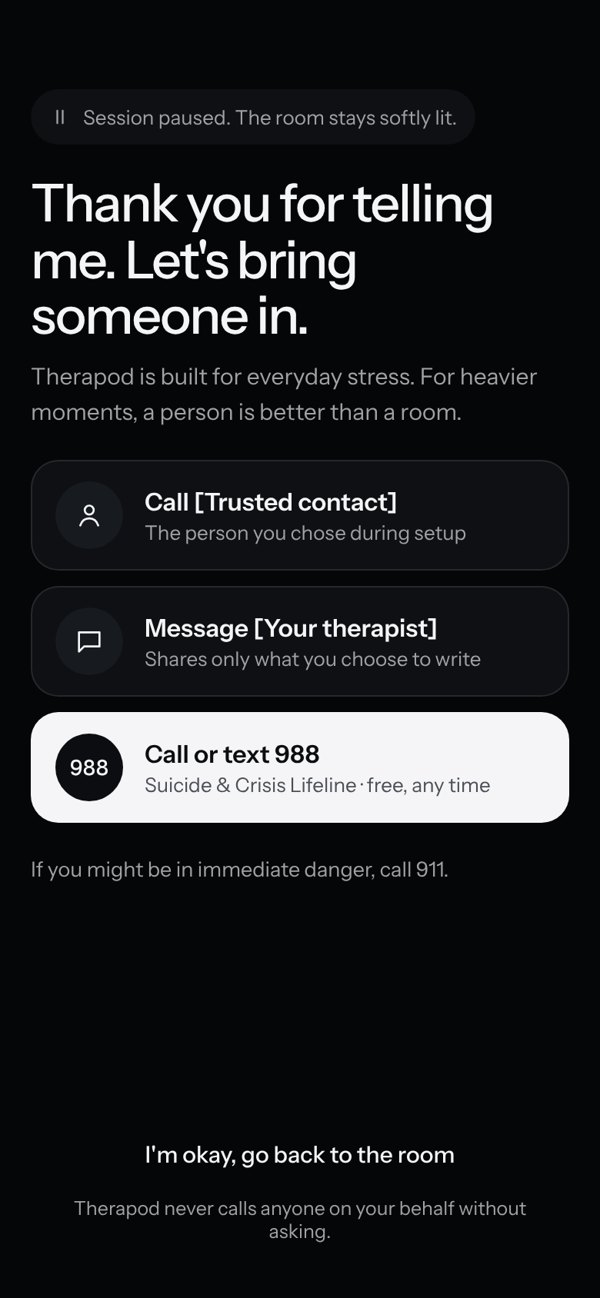
Escalation
When it's more than stress, Therapod doesn't pretend.
- Trigger. Her own words, or a pattern she opted into. Never a sensor alone.
- Pause. The session stops; the room stays softly lit.
- Offer, never force. Her trusted person, her therapist, or 988 (call or text, free, any time).
- "Not now" is respected. No nagging. The options stay one tap away.
- Nothing is shared automatically. Every contact needs her tap.
Brand and launch
Calm is a pace.
The brand rests on one idea: everything moves at six breaths a minute, four seconds in and six out. The mark, the motion, the sound and the film all follow it.
 Therapod
The mark is the device seen from above: the titanium body and its ring of light, the one part of Therapod that moves.
Rules that make it Therapod
- Colour is meaning. Aurora only when Therapod is acting, under 5% of any surface. The heat ramp is only ever the body. No red or green status colours: Therapod doesn't grade people.
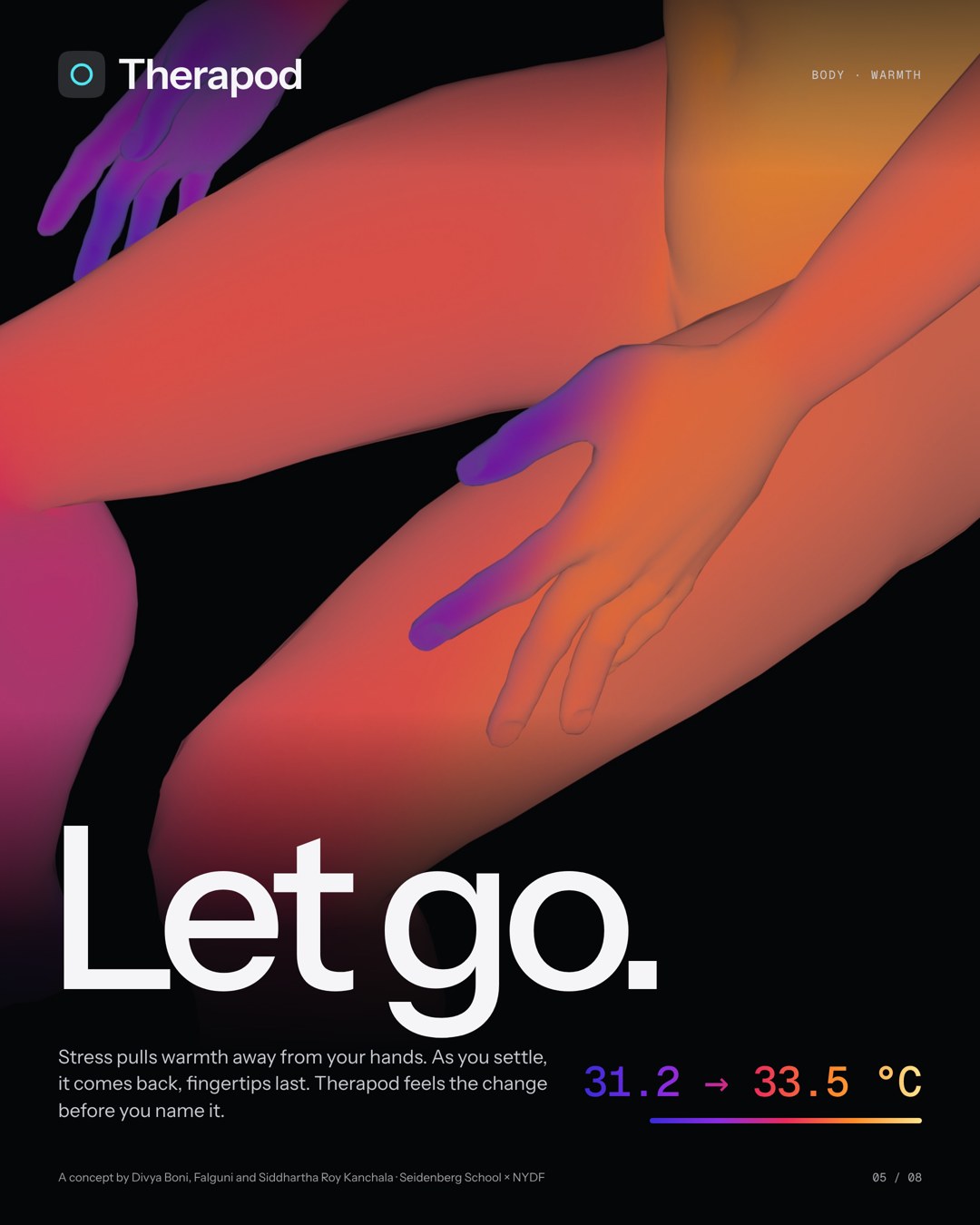
- Show the body gently. The body appears as warm light, in profile, never as a chart that grades it.
- Write like a calm person sitting next to you. "Your hands are warming", never "stress detected".
- Motion breathes. Four seconds in, six out, sine-eased. Nothing bounces.
Packaging
Soft-touch black with a single ring printed in luminous ink: the same ring that breathes on the device. The side reads "Mental clarity, made tangible." The other side lists the four senses: light, sound, scent and touch. No claims, no stock photos.
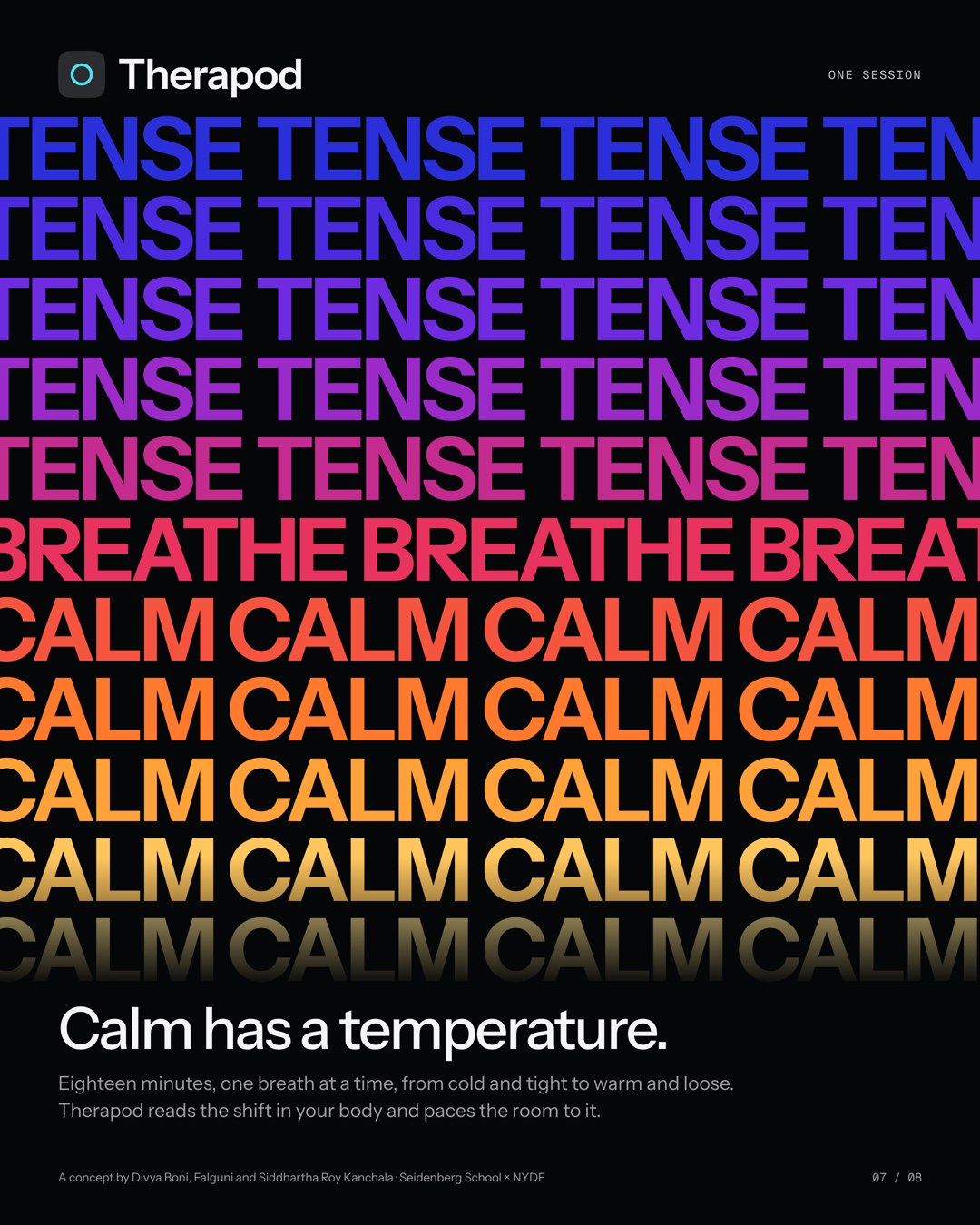
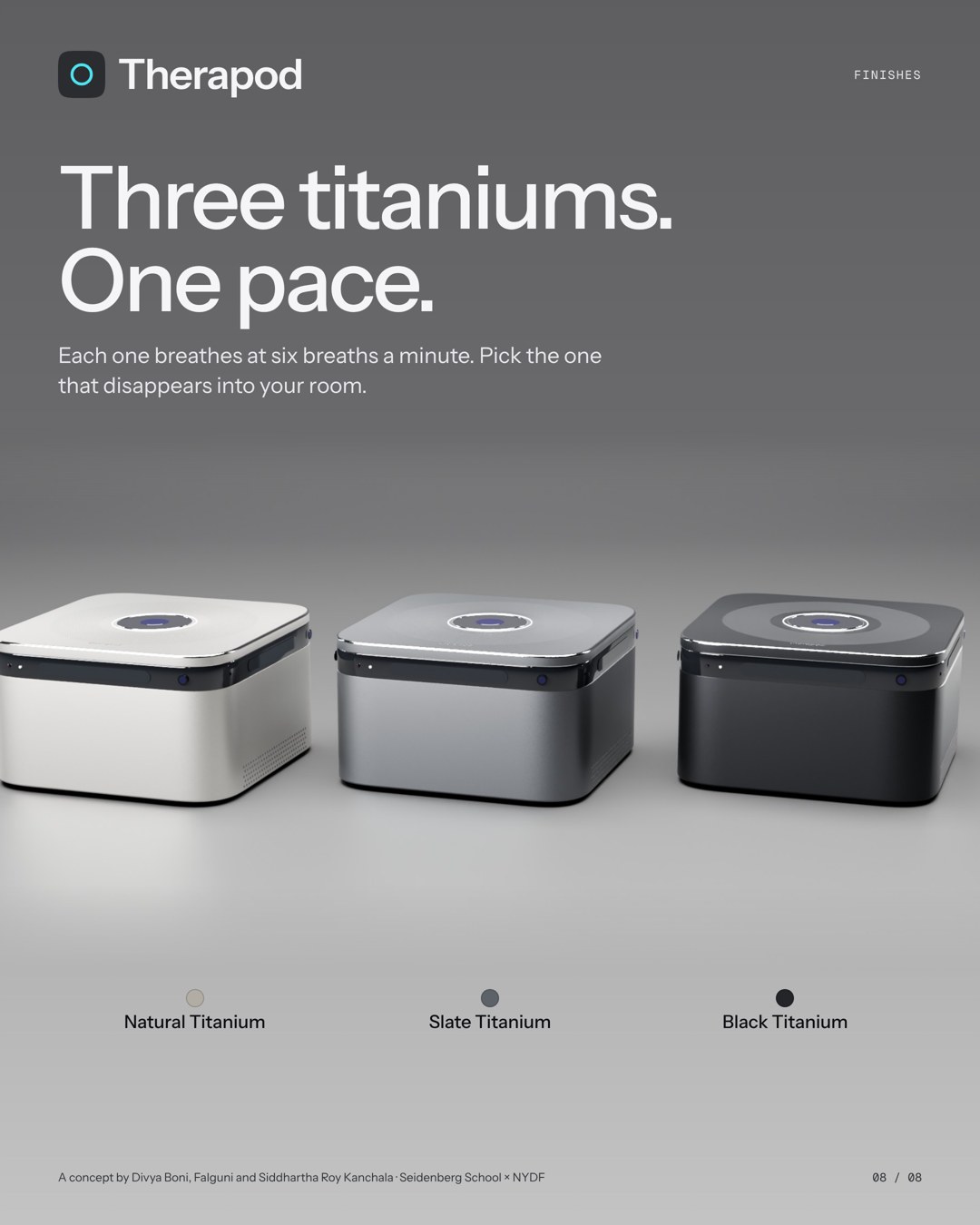
Launch posters
The 2040 app · eight screens
Reflection
Where it stands, and where it could go.
Where it stands
A speculative concept for 2040, not tested with users. It has a product, a service, a brand, packaging, an app, two films and an interactive build. Every reading shown is simulated, and it is not a medical device.
Where it could go
- Clinics as partners. A clinic offers Therapod the day someone joins its waitlist.
- Clinicians as co-designers of the summary, so it saves time in a first appointment.
- Between sessions, a clinician could suggest a pace or a routine, and she decides whether to use it.
What success would mean
Not more minutes in the app. People feeling steadier during the wait, more of them making it to that first appointment, and arriving with something useful to say.
The more a product knows about you, the more visible and reversible it has to be. The sensor light, the check-in that wins, and "erase everything" matter more than any feature.
The device got clearer once it had a job: the weeks between asking for help and getting it. Everything else, from the learning to the summary, followed from that.
Cutting the weakest claims, like a 528 Hz "healing" sound, made the product more honest and more focused.
The escalation path took more care than any screen. A calm device that misses a crisis is worse than no device at all.
Sources
- NCHS (2024). Symptoms of anxiety and depression among adults, 2019–2022.
- Gallup. State of the Global Workplace.
- SAMHSA. NSDUH 2024, mental health treatment.
- HRSA (2025). Behavioral Health Workforce Brief.
- Sun et al. (2023). Low availability, long wait times, and high geographic disparity of psychiatric outpatient care in the US. General Hospital Psychiatry.
- Lehrer & Gevirtz (2014). Heart rate variability biofeedback: how and why does it work? Frontiers in Psychology.
- Baumel et al. (2019). Objective user engagement with mental health apps. JMIR.
- Arup. 2050 Scenarios: four plausible futures.
- WFH Research (Dec 2025).
- Berg Insight via CE Pro. North American smart homes by 2029.
- WHO (2025). Commission on Social Connection.
- Hickman et al. (2021). Climate anxiety in children and young people.
- Goessl et al. HRV biofeedback and stress: a meta-analysis. Psychological Medicine.
- Fincham et al. (2023). Breathwork RCTs. Scientific Reports.
- de Witte (2020). Music interventions for stress reduction.
- Akimoto et al. (2018). 528 Hz pilot study.
- Donelli et al. (2019). Lavender inhalation and anxiety.
- Max Planck (2025). Virtual forest bathing.
- Lopes et al. (2024). Congruent scent in virtual environments.
- Pew (2023). Americans and AI in health care.
- 988 Suicide & Crisis Lifeline.